
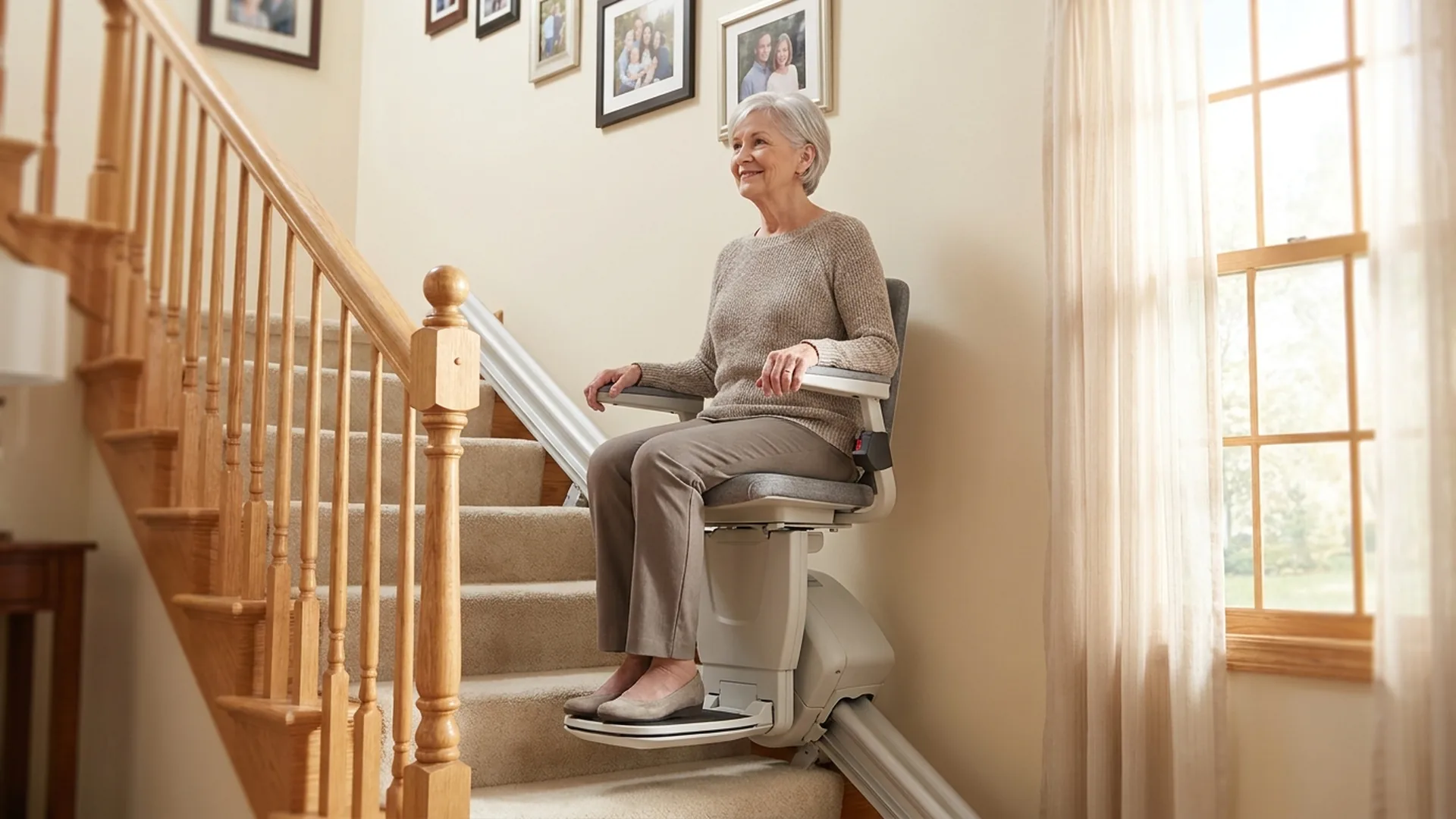
The stairs are usually where it starts. A knee gives out, a walker comes home from the hospital, and the bedroom or the only full bathroom is suddenly on the wrong floor. The question that follows is almost always about money: who pays for the stair lift or the ramp?
Yes. Minnesota Medicaid, which the state calls Medical Assistance, pays for stair lifts, wheelchair ramps, grab bars, and accessible bathrooms when the person is on one of six DHS waiver programs.
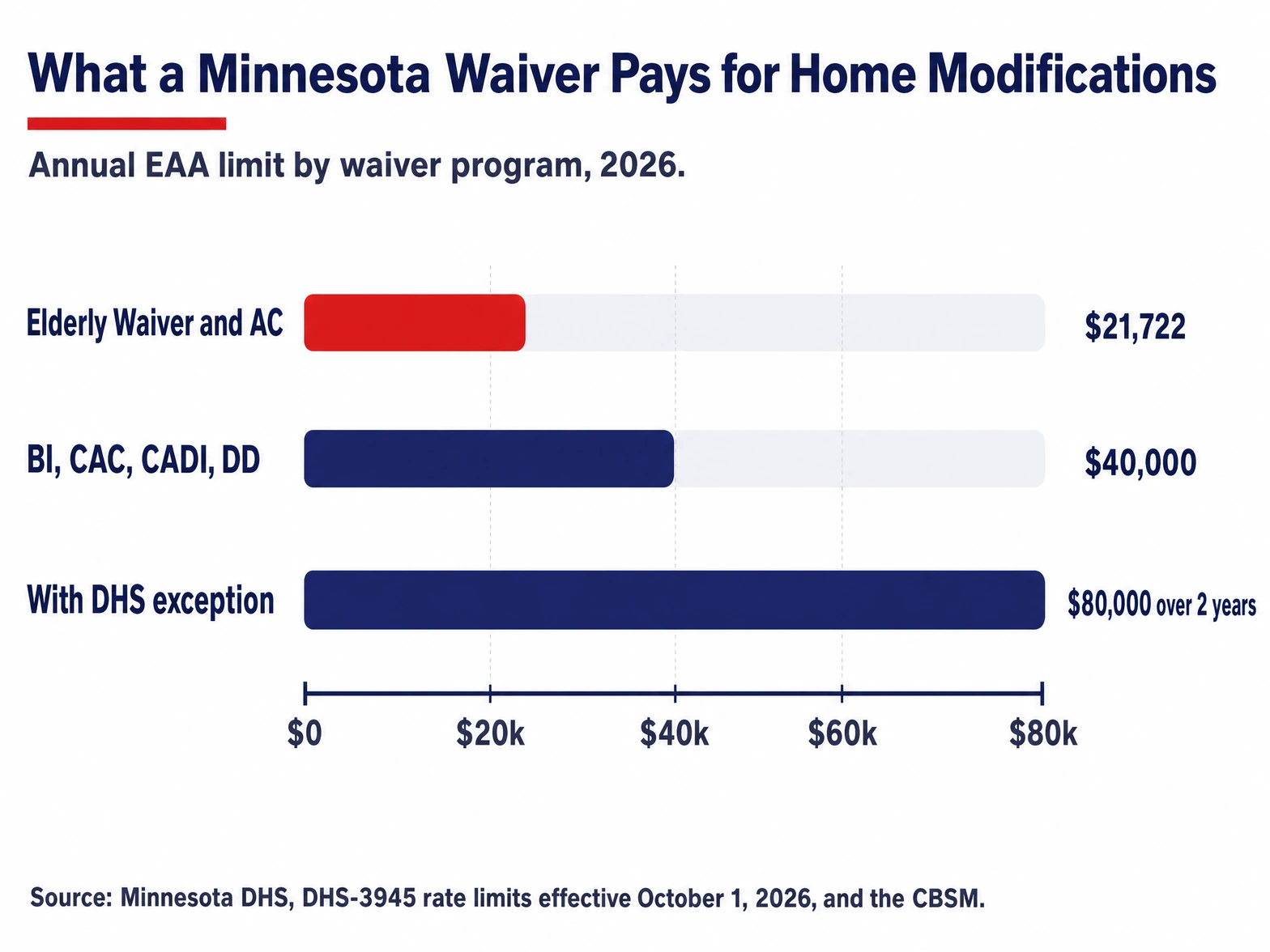
The service is called environmental accessibility adaptations, or EAA. In 2026, the Elderly Waiver allows up to $21,722 per year for these projects, and the disability waivers allow up to $40,000.
That’s the short answer. The longer answer matters, because the rules decide what gets approved, what you’ll pay out of pocket, and how long the project takes. We’ve been a DHS waiver provider in Minnesota for years, and the same questions come up on nearly every referral. This guide answers them in one place, for families and for case managers.
Key Takeaways
- Six Minnesota waivers cover home modifications through EAA: Alternative Care, Elderly Waiver, BI, CAC, CADI, and DD (Minnesota DHS, 2026).
- Elderly Waiver and Alternative Care cap EAA at $21,722 per waiver year under the rate limits effective October 1, 2026. Disability waivers cap it at $40,000, with exceptions up to $80,000 over two years.
- Original Medicare pays nothing toward stair lifts or ramps. Waivers do.
- Every project needs prior authorization from the county or tribal lead agency before work begins.
Which Minnesota Waivers Pay for Home Modifications?
As of 2026, the Minnesota Department of Human Services lists six programs that cover environmental accessibility adaptations: Alternative Care (AC), Elderly Waiver (EW), Brain Injury (BI), Community Alternative Care (CAC), Community Access for Disability Inclusion (CADI), and Developmental Disabilities (DD), according to the DHS Community-Based Services Manual (CBSM, Environmental accessibility adaptations).
If you’re enrolled in any of these, home modifications are a covered service.
DHS defines EAA as “physical adaptations to a person’s primary home or primary vehicle to ensure the person’s health and safety or enable them to function with greater independence.” That definition does a lot of work. It rules in stair lifts and ramps. It rules out anything that’s mainly for comfort.
Here’s a quick way to tell the programs apart:
| Program | Who it serves | Funding source |
|---|---|---|
| Elderly Waiver (EW) | Age 65+, eligible for Medical Assistance, needs nursing-home level of care | Medicaid waiver |
| Alternative Care (AC) | Age 65+, needs nursing-home level of care, not yet eligible for Medical Assistance | State-funded |
| CADI | People with disabilities who need nursing-facility level of care | Medicaid waiver |
| BI | People with a qualifying brain injury | Medicaid waiver |
| CAC | People who are chronically ill or medically fragile and need hospital level of care | Medicaid waiver |
| DD | People with developmental disabilities or related conditions | Medicaid waiver |
One question we hear constantly: is Medical Assistance the same thing as Medicaid? Yes. Medical Assistance is simply Minnesota’s name for its Medicaid program. When a national website says “Medicaid covers home modifications through a waiver,” that’s the Elderly Waiver or one of the disability waivers here.
Regular Medical Assistance on its own does not pay for a stair lift. The waiver is what makes it possible. That’s why the first step for most families is a MnCHOICES assessment through the county or tribal nation, not a call to a contractor.
What Home Modifications Does EAA Actually Cover?
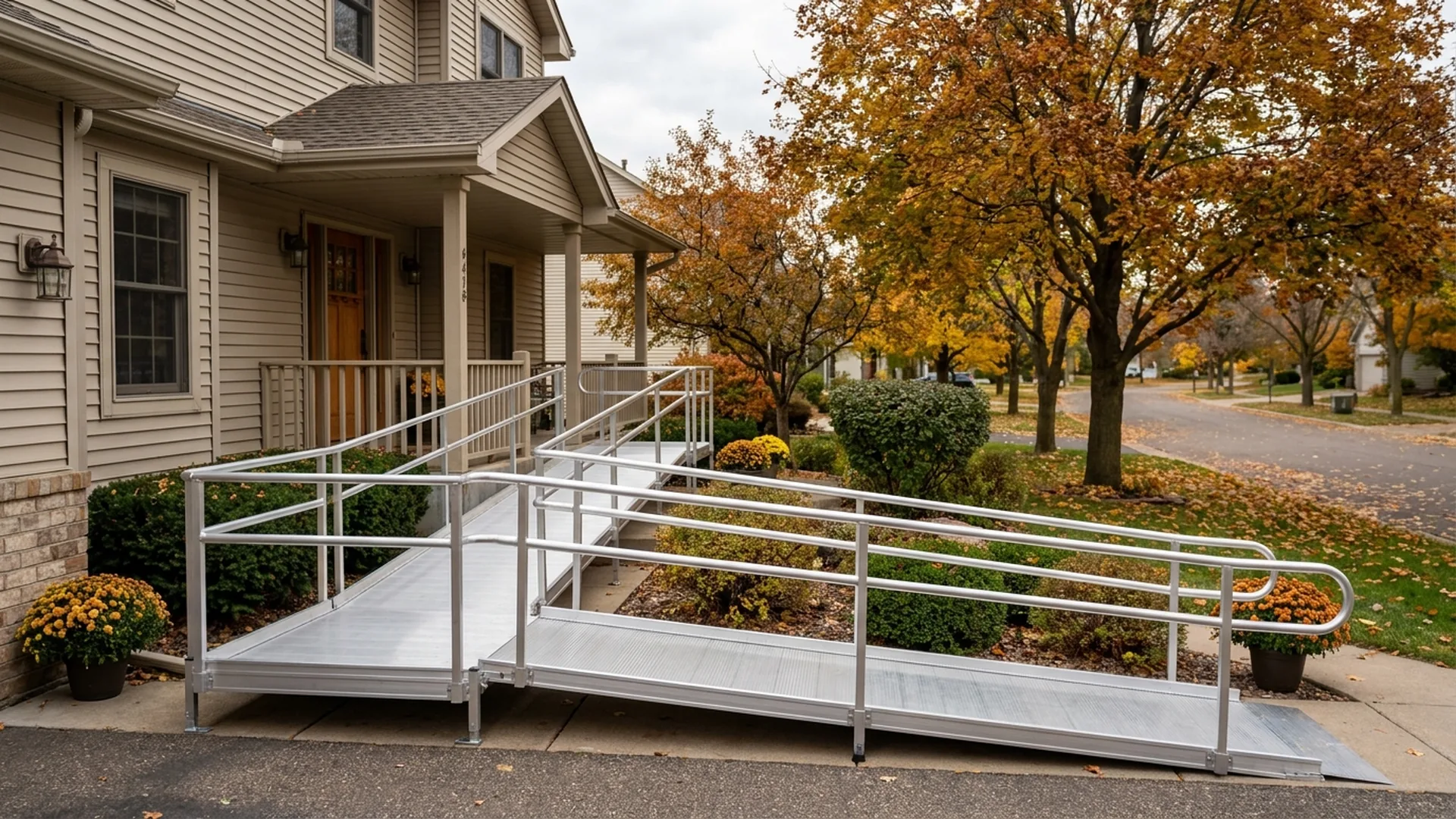
DHS names the covered items directly. The Community-Based Services Manual names bathroom and kitchen modifications including grab bars, ramps, widened doorways, accessible flooring, and specialised electrical and plumbing work among covered home modifications, and elsewhere gives stair lifts, vertical platform lifts, accessible-height cabinets and ceiling track systems as examples of work that increases functional use of the home (CBSM, 2026). Vehicle modifications such as lifting devices, wheelchair securing devices, handrails, and door widening are covered too.
In practice, most of the referrals we see fall into four groups:
- Getting between floors. Straight, curved, and outdoor stair lifts, plus vertical platform lifts for wheelchair users.
- Getting in the door. Aluminum or wood wheelchair ramps, automatic door openers, and entry safety rails.
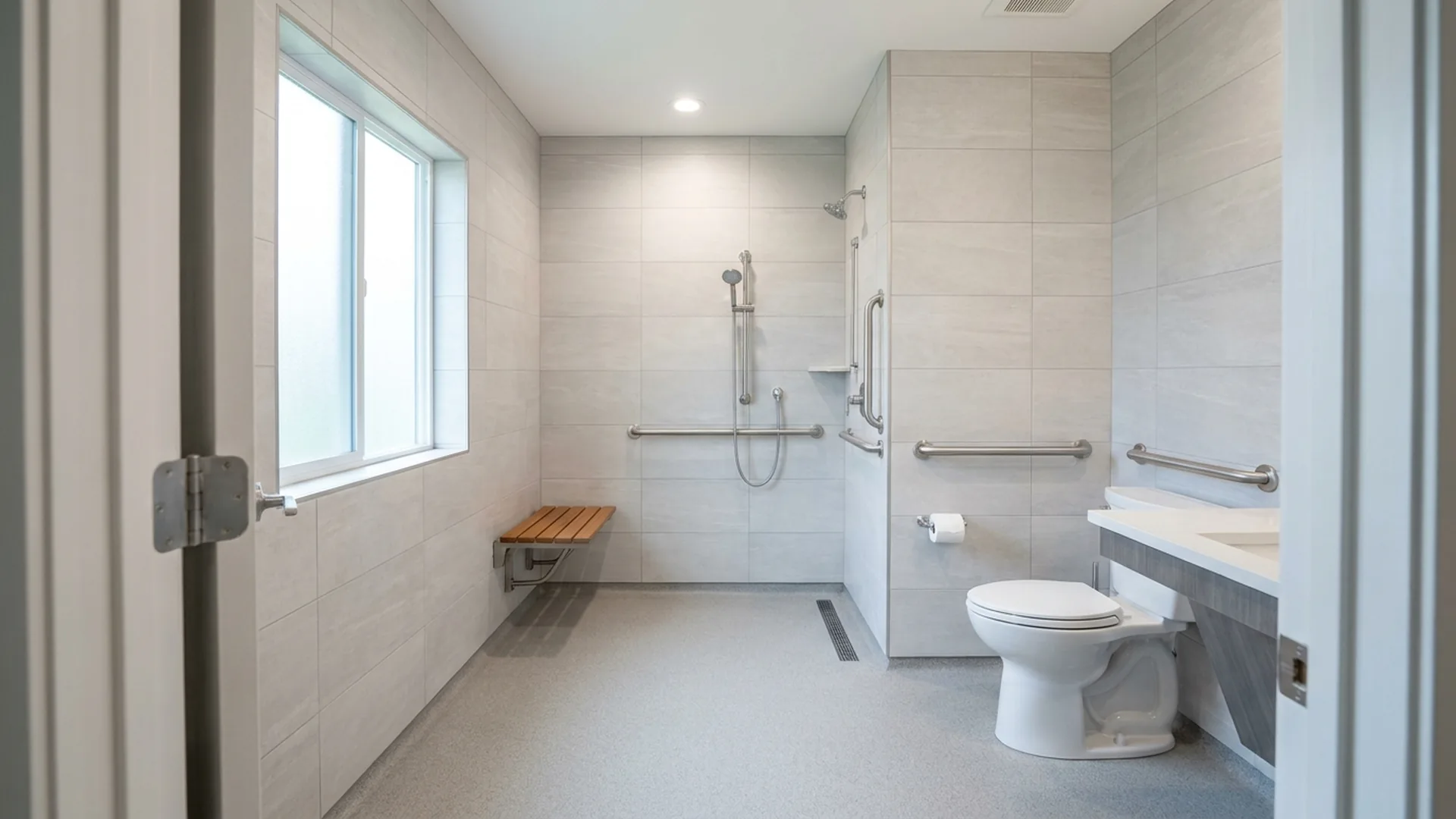
- Using the bathroom safely. Roll-in showers, walk-in or accessible tubs, grab bars, and ADA-height toilets. See our accessible bathroom page for examples.
- Getting around town. Vehicle wheelchair lifts and ramps.
The test for every item is the same. It has to be necessary to meet a need identified in the person’s assessment, for the direct benefit of the person, and related to their disability or condition. If a modification passes all three, it’s eligible. If it fails one, the lead agency can deny that piece while approving the rest (DHS, EAA FAQ, updated July 31, 2026).
Here’s something the policy pages don’t spell out. A bathroom is rarely just a bathroom. If the only accessible bathroom is on a different floor than the bedroom, the lead agency is allowed to consider the stair lift as part of the same need. DHS uses that exact example in its FAQ.
When we do a home assessment, we look at the whole path from bed to bathroom to front door, because that’s how the county will look at it too.
How Much Will a Minnesota Waiver Pay for Home Modifications?
Under the DHS rate limits effective October 1, 2026, the Elderly Waiver and Alternative Care limit EAA to $21,722 per waiver year, according to the DHS rate sheet Long-Term Services and Supports Service Rate Limits, DHS-3945. The BI, CAC, CADI, and DD waivers allow up to $40,000 per year. That single difference decides what’s realistic for a given project.
A few details behind those numbers:
- Elderly Waiver and AC have no exception process. DHS states plainly that the $21,722 limit can’t be exceeded, and the full cost comes out of the person’s individual waiver budget. The limit does rise each January with the Consumer Price Index, so the 2027 figure will be higher.
- Disability waivers can request an exception. For BI, CAC, CADI, and DD, the lead agency can ask DHS to approve up to an additional $40,000, for a federal maximum of $80,000 across two years. The request needs form DHS-5504B, a checklist, two comparison bids, and any home assessment that was completed.
- Projects can be split across two waiver years. DHS allows a $40,000 project to straddle two service agreement years, as long as a half-finished modification doesn’t create an unsafe situation.
- Consumer-directed budgets have their own rule. If you use CDCS on a disability waiver and a project carries into a new plan year, or you do more than one project in the same year, DHS can require an additional $5,000 from your CDCS budget. On AC or EW, CDCS users get the same $21,722 limit inside their case-mix budget cap.
How far does $21,722 go? Farther than most people expect. Stair lifts run about $2,500 to $15,000 installed, depending on whether the staircase is straight or curved and the features you choose, according to the National Council on Aging (NCOA, Best Stair Lifts of 2026). Those are national starting prices across brands. Our own Minnesota stair lift pricing runs $3,000 to $15,000 installed for a straight rail, with curved rails from about $10,000, because the rail is built to your staircase.
A modular aluminum ramp is usually the least expensive of these projects. A full walk-in shower installation, meaning a new pan, tile and glass, runs about $4,000 to $20,000 and averages around $12,000, with curbless roll-in designs at the higher end, according to This Old House. Converting a shower that is already big enough costs far less; our guide to accessible bathroom remodel costs breaks the pieces out separately (This Old House, 2026). A straight stair lift plus a basic accessible bathroom often fits inside a single Elderly Waiver year, though a curved lift or a large remodel can use most of it.
The trap is the curved stair lift. A curved rail alone can consume most of an Elderly Waiver year. If a straight staircase has a landing, two straight rails are sometimes approved instead of one custom curved rail, at a fraction of the price. It’s worth asking the assessor about before bids go out.
What Won’t a Minnesota Waiver Pay For?
DHS excludes anything that isn’t tied to the assessed need, and its July 2026 FAQ gives concrete examples (Minnesota DHS, 2026). Knowing these ahead of time prevents a denied bid and a lost month.
- Comfort and convenience items. Jetted or whirlpool tubs are the classic example. DHS calls them “nice to have” and won’t fund them. An accessible soaker tub that meets the need is fine.
- Household appliances. A new water heater to fill a larger tub is the homeowner’s cost, even if the tub itself is covered. A water heater booster is sometimes an alternative.
- Homeowner responsibilities. If your electrical panel isn’t up to code, bringing it up to code is on you. If the panel is fine but a ceiling lift needs a new circuit, that circuit is covered. DHS uses this exact pair of examples.
- Added square footage. Building an addition falls under a separate DHS policy with its own rules and bid requirements.
- Project management, automatic locks, and behavior-related repairs. All three are specifically excluded.
- Upgrades beyond the need. You can choose marble over linoleum, but you pay the difference plus any extra labor under a separate private-pay agreement with the contractor.
Does Medicare Pay for Home Modifications Instead?
No. Original Medicare does not cover stair lifts, ramps, or grab bars, because Medicare Part B classifies them as home modifications rather than durable medical equipment, according to the National Council on Aging (NCOA, Medicare and Stair Lifts). Private health insurance rarely covers them for the same reason.
Some Medicare Advantage (Part C) plans include a small home-safety allowance, but NCOA notes this isn’t common and usually covers only a fraction of the cost. If you have a Part C plan, call the plan and ask specifically about “home safety modifications” before assuming anything.
So if you’re 65 or older in Minnesota and need a stair lift, the realistic funding paths are the Elderly Waiver or Alternative Care, a VA housing grant such as SAH or SHA if you’re an eligible veteran (U.S. Department of Veterans Affairs), or private pay. With a doctor’s prescription, you may also be able to put tax-free FSA or HSA dollars toward a stair lift, according to NCOA. That’s a question for your tax preparer.
How Does the Referral and Approval Process Work?
Every waiver-funded home modification in Minnesota requires prior authorization from the lead agency before any work is done, according to the DHS Guide to home modifications under EAA (reviewed April 24, 2024). A contractor who starts before authorization won’t be paid by the waiver, and you can’t be billed for it either.
Here’s the sequence as it plays out for the families we work with.
- Get on a waiver. For the Elderly Waiver, contact your county or tribal nation to schedule a MnCHOICES assessment. You must be 65 or older, eligible for Medical Assistance, and meet nursing-home level of care. Minnesota Aging Pathways at 800-333-2433 can connect you with local help.
- The case manager identifies the need. The modification has to trace back to something in the assessment. “Can’t safely climb stairs to the only bathroom” is a need. “Would like a nicer bathroom” isn’t.
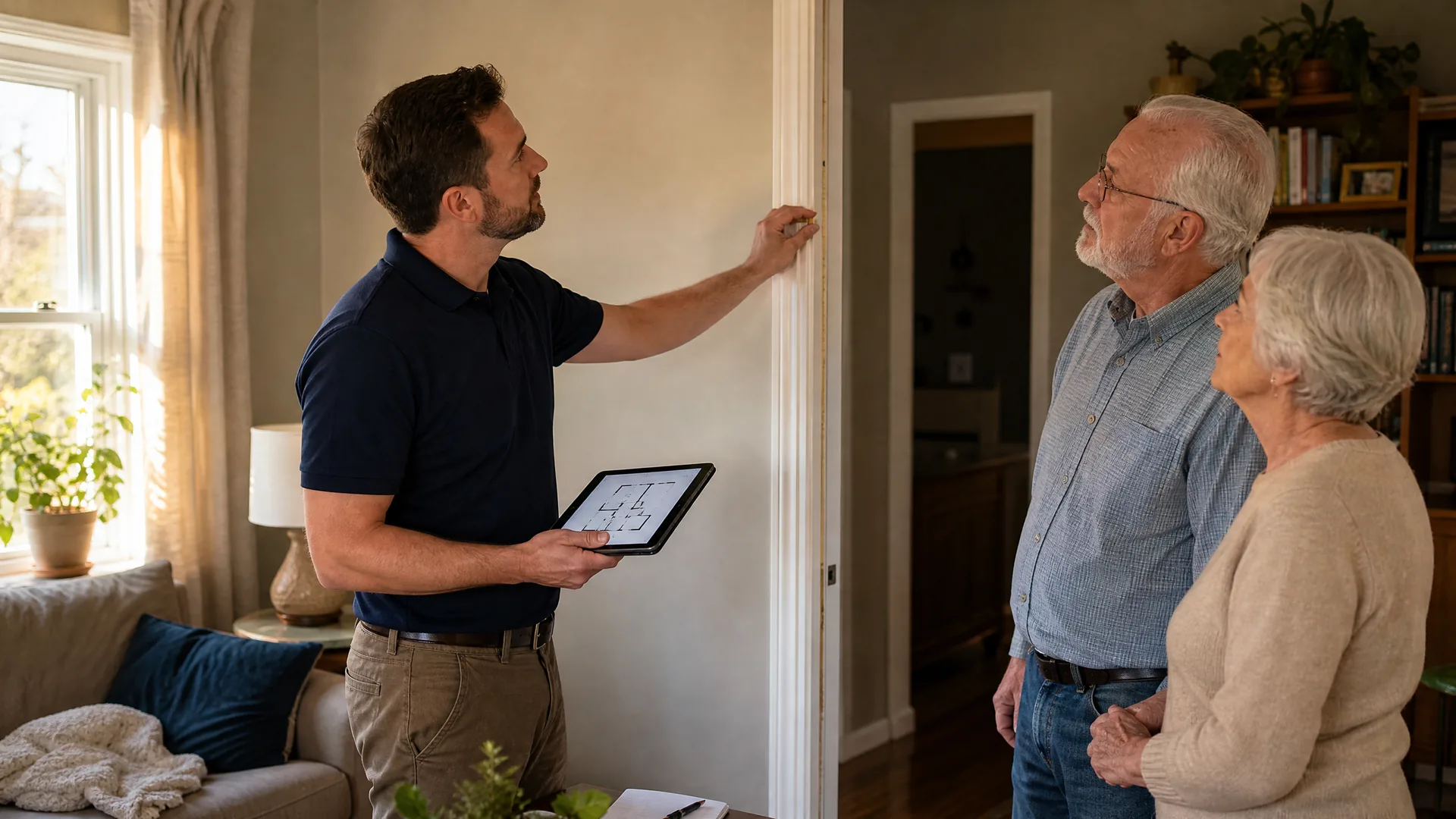
- A home assessment, if the project is complex. DHS says an EAA assessment professional, such as an occupational therapist, physical therapist, accessibility specialist, or certified aging-in-place specialist, can determine the modification, confirm it meets ADA guidelines, and recommend cost-effective options. Small jobs like grab bars usually skip this step.
- Bids are gathered. Two comparison bids are required for exception requests and added-square-footage projects. For everything else, DHS calls two bids best practice. Bids must be itemized and show material costs. The lead agency may share a scope-of-work template with contractors but must not share one contractor’s bid with another.
- The lead agency picks the most cost-effective bid. DHS is explicit that this “does not always mean the cheapest option.” A low bidder with a history of poor work or long delays can be passed over. You also keep the right to choose from any qualified, willing provider.
- Authorization, then installation. The lead agency authorizes the project, often on separate line items for materials, a start payment, and final payment.
- Final walk-through. The last payment is released after a city inspection, the assessor, or the case manager verifies the work and you confirm it meets your needs.
If you rent, the landlord’s written permission is needed first. DHS confirms that modifications to Section 8 housing and provider-controlled settings can be authorized, as long as the home meets the definition of the person’s primary residence.
Why Does Minnesota Fund Home Modifications at All?
Because falls are expensive and staying home is what people want. In 2024, falls among Minnesotans 65 and older caused about 12,000 hospitalizations and 30,000 emergency department visits, and Minnesota has the second-highest older-adult fall death rate in the country, according to the Minnesota Department of Health (MDH, Preventing Falls).
Nationally, more than one in four adults 65 and older falls each year (CDC, February 2026).
The waiver exists because a $6,000 stair lift is cheaper than a nursing facility. That’s literally the eligibility test: the person must need services the waiver can provide “for less than the cost of care in a nursing home.” Home modifications are one of the best-value services in the whole program.
Families agree. AARP’s 2024 Home and Community Preferences Survey found that 75% of adults 50 and older want to stay in their current home as they age, and 72% of those who expect to modify their home plan to add bathroom safety features such as grab bars and non-slip flooring (AARP, 2024).
What we see on the ground matches the data. Stairs are the tipping point. Someone manages fine for years, then a knee or a hip makes the basement laundry or the upstairs bedroom unreachable. The stair lift usually goes in within a week of authorization, and the conversation about moving stops.
Need a Bid for a Waiver-Funded Home Modification?
Ocel Builders is a DHS waiver provider (NPI/UMPI #1669715397) and a Certified Aging-in-Place Specialist. We give itemized bids that match DHS requirements, and we schedule in-home visits within 24 hours.
What Should Case Managers Know About Working With a Waiver Provider?
DHS requires that EAA assessment providers hold a relevant credential and that installers meet applicable building codes and professional standards (CBSM, EAA provider standards). Assessments are a DHS-enrollment-required service. Installation can be done by a DHS-enrolled provider or an approval-option vendor the lead agency oversees.
That’s why credentials matter when you’re picking who to send a referral to. Here’s what we bring to a waiver project, so you can compare:
- Certified Aging-in-Place Specialist (CAPS) through the National Association of Home Builders, since 2006. That’s one of the credentials DHS names for EAA assessment.
- Minnesota Builders License BC 590012 and Minnesota Elevator Contractor License LC 714181, so stair lifts and platform lifts are installed by a contractor licensed for that equipment.
- Enrolled DHS waiver provider with an NPI/UMPI number, which means claims can be billed directly to the waiver.
- Spenddown and waiver-obligation billing handled correctly. DHS requires providers to bill the person for any spenddown portion, and we do that transparently.
- Licensed, bonded, insured, warrantied work, with a BBB A+ rating and daily clean-up.
Our DHS waiver referral form asks for exactly what the lead agency will need: the client’s information, the case manager and financial coordinator, which waiver applies, whether there’s a spenddown, whether CDCS funding is involved, and a description of the modification detailed enough for comparable bids. If you’re paying privately, use the private pay referral form instead.
Frequently Asked Questions
Does Medicaid Pay for Home Modifications in Minnesota?
Yes, through a waiver. Regular Medical Assistance doesn’t pay for stair lifts or ramps, but six waiver programs cover them as environmental accessibility adaptations. As of 2026, the Elderly Waiver and Alternative Care allow up to $21,722 per waiver year, and the BI, CAC, CADI, and DD waivers allow up to $40,000, per Minnesota DHS.
Is Minnesota Medical Assistance the Same as Medicaid?
Yes. Medical Assistance is Minnesota’s Medicaid program. To use the Elderly Waiver, DHS requires that you be 65 or older, eligible for Medical Assistance, meet nursing-home level of care through a MnCHOICES assessment, and need services that cost less than a nursing home would.
Will a Minnesota Waiver Pay for a Bathroom Remodel?
It pays for the accessibility parts. EAA covers grab bars, roll-in showers, accessible tubs, and ADA-height fixtures that meet an assessed need. It won’t cover a jetted tub, a bigger water heater, or cosmetic finishes. A full walk-in shower installation runs $4,000 to $20,000 according to This Old House, though converting an existing shower costs considerably less, and the accessibility elements a waiver covers fit within either waiver limit.
Does Medicare Pay for Home Modifications?
No. Original Medicare classifies stair lifts, ramps, and grab bars as home modifications, not durable medical equipment, so Part B doesn’t cover them, according to the National Council on Aging. A few Medicare Advantage plans offer a limited home-safety allowance. Ask your plan directly.
How Long Does a Waiver-Funded Home Modification Take?
Plan on several weeks to a few months from referral to final walk-through, mostly for assessment, bids, and authorization. The installation itself is quick. NCOA notes a stair lift install takes only an afternoon. Ramps and bathrooms take longer.
The Bottom Line
Minnesota Medicaid does cover home modifications, but only through a waiver, only after prior authorization, and only for items tied to an assessed need. The Elderly Waiver and Alternative Care allow $21,722 per year in 2026. The disability waivers allow $40,000, with exceptions up to $80,000 over two years. Medicare covers none of it.
If you’re not on a waiver yet, start with a MnCHOICES assessment through your county. If you are, talk to your case manager about the need first and the product second. When you’re ready for a bid, we’re glad to come out. Learn more about the stair lifts, ramps, and bathroom options we install on our services page, or read about our licenses and certifications.
This article is general information, not legal or benefits advice. Waiver limits and rules change. Confirm current figures with your lead agency or the DHS rate sheet linked below.
Last reviewed 31 October 2026. This article is general information about Minnesota Medical Assistance waiver programmes, not legal, medical or benefits advice. DHS resets the EAA service limits each January, eligibility turns on an individual assessment, and only your lead agency can authorise a project. Confirm anything you plan to rely on with your case manager or lead agency before work begins.
Sources
- Minnesota Department of Human Services, “CBSM – Environmental accessibility adaptations,” retrieved 2026-09-04, https://www.dhs.state.mn.us/id_002196/
- Minnesota Department of Human Services, “Frequently asked questions about EAA,” updated 2026-07-31, retrieved 2026-09-04, https://mn.gov/dhs/partners-and-providers/news-initiatives-reports-workgroups/long-term-services-and-supports/waiver-policy/index.jsp
- Minnesota Department of Human Services, “Long-Term Services and Supports Service Rate Limits, DHS-3945,” effective 2026-10-01, retrieved 2026-10-31, https://edocs.dhs.state.mn.us/lfserver/Public/DHS-3945-ENG
- Minnesota Department of Human Services, “CBSM – Guide to home modifications under the environmental accessibility adaptations (EAA) service,” reviewed 2024-04-24, retrieved 2026-09-04, https://www.dhs.state.mn.us/main/idcplg?IdcService=GET_DYNAMIC_CONVERSION&RevisionSelectionMethod=LatestReleased&dDocName=dhs-288900
- Minnesota Department of Human Services, “Elderly Waiver,” updated 2026-07-29, retrieved 2026-09-04, https://mn.gov/dhs/disability-aging/home-and-community-services/programs-and-services/elderly-waiver/
- Minnesota Department of Human Services, “Long-term services and supports rates changes,” retrieved 2026-09-04, https://mn.gov/dhs/partners-and-providers/news-initiatives-reports-workgroups/long-term-services-and-supports/ltss-rates/index.jsp
- National Council on Aging, “Medicare and Stair Lifts: A Coverage Guide for Older Adults,” retrieved 2026-09-04, https://www.ncoa.org/article/medicare-and-stair-lifts/
- National Council on Aging, “Your Guide to the Best Stair Lift Brands of 2026,” retrieved 2026-09-15, https://www.ncoa.org/product-resources/mobility/best-stair-lifts/
- This Old House, “How Much Does a Walk-In Shower Cost? (2026 Pricing),” retrieved 2026-09-15, https://www.thisoldhouse.com/bathrooms/walk-in-shower-cost
- U.S. Department of Veterans Affairs, “Disability housing grants for Veterans,” retrieved 2026-09-15, https://www.va.gov/housing-assistance/disability-housing-grants/
- Minnesota Department of Health, “Preventing Falls,” retrieved 2026-09-04, https://www.health.state.mn.us/people/falls/index.html
- Centers for Disease Control and Prevention, “Older Adult Falls Data,” updated 2026-02-26, retrieved 2026-09-04, https://www.cdc.gov/falls/data-research/index.html
- AARP, “2024 Home and Community Preferences Survey,” retrieved 2026-09-04, https://www.aarp.org/pri/topics/livable-communities/housing/2024-home-community-preferences/