
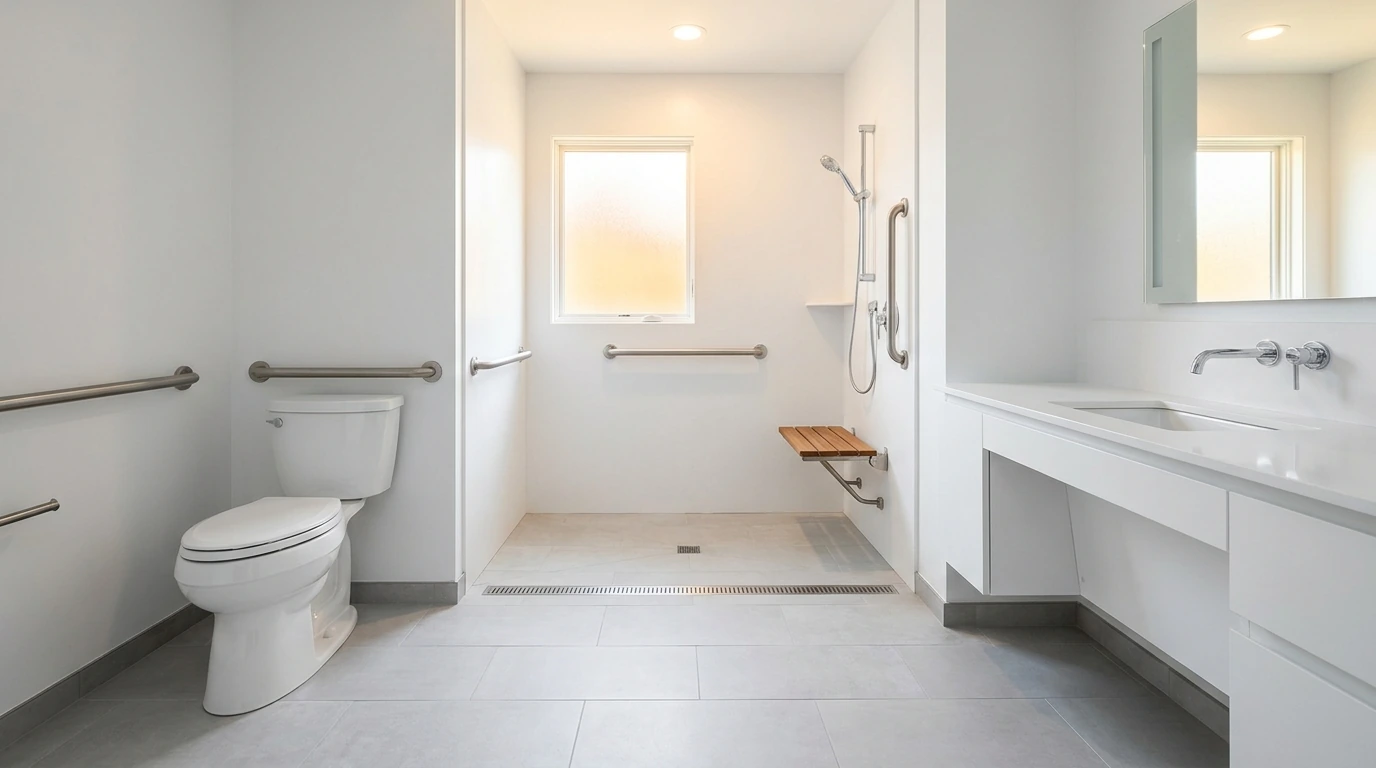
Most Minnesota families don’t call a bathroom remodeler when a parent starts struggling with the tub. They start pricing a different house, or they call about assisted living. The fix is usually cheaper than any of that. The average accessible bathroom remodel in 2026 runs about $8,400, and state waivers can cover most or all of it for people who qualify.
The bathroom is where independence usually breaks down first. Everyone uses it several times a day, alone, on wet hard floors. You step over a tub wall. You lower onto a toilet that’s a few inches too short.
An accessible bathroom remodel fixes those problems. It doesn’t have to look like a hospital, and it doesn’t have to cost what a luxury renovation does.
This guide covers what an accessible bathroom costs in 2026 and which features are worth paying for. Whether you call it a senior bathroom remodel, a handicap bathroom remodel, or an aging-in-place conversion, the same measurements and funding rules apply. It also gives the measurements a good design starts from, and explains how Minnesota homeowners can get some or all of it paid for.
If you’re planning for a parent, a spouse, or yourself, it will help you set a budget and ask a contractor the right questions.
Key Takeaways
- Most accessible bathroom remodels cost $2,700 to $16,000, with an average of about $8,400 (HomeAdvisor, June 2026).
- Falls caused 81.1% of nonfatal bathroom injuries in a CDC analysis, and the injury rate rose with age, from 112 per 100,000 at ages 65 to 74 to 515 at 85 and older.
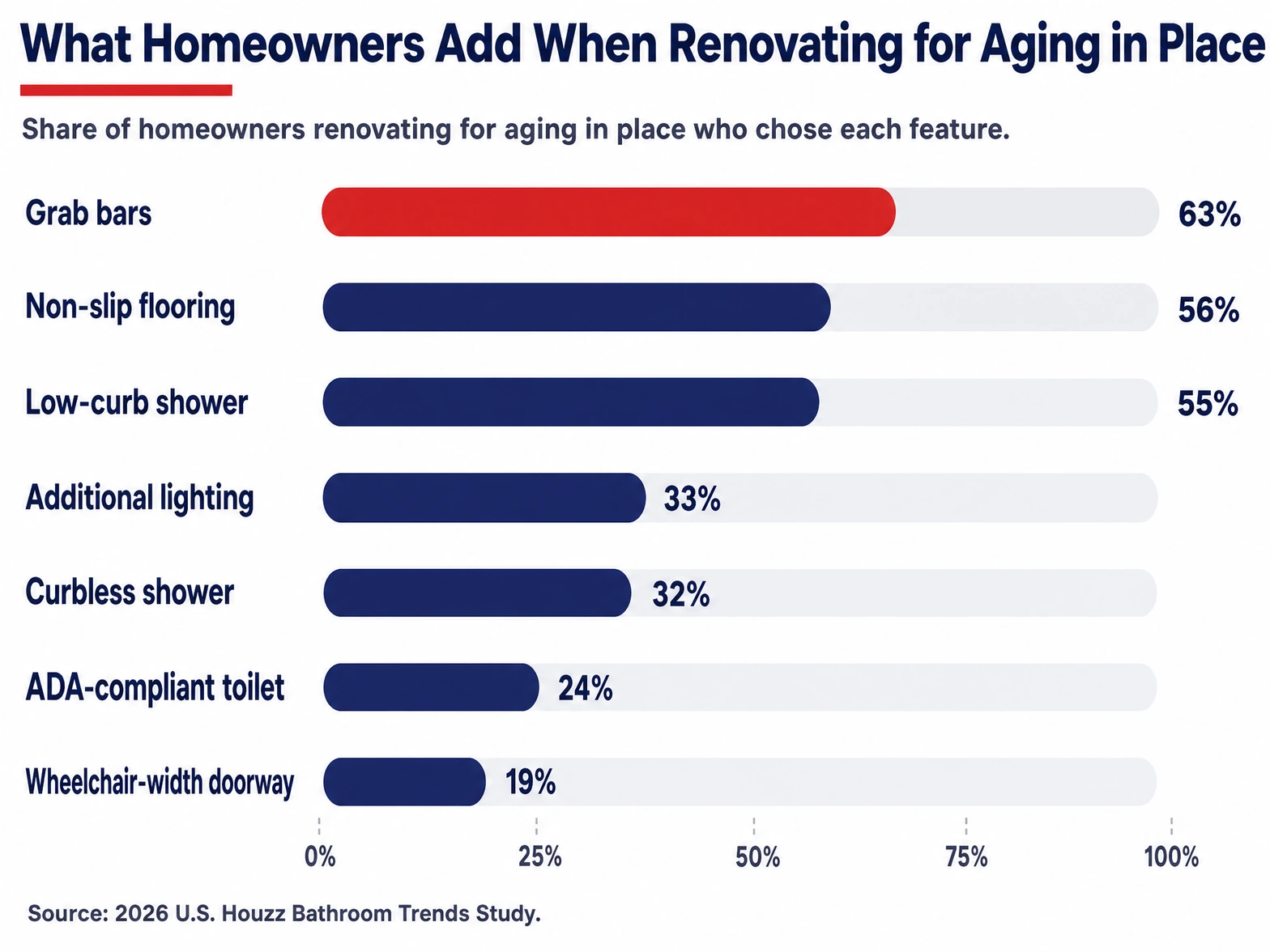
- Grab bars, non-slip flooring, and a low-curb or curbless shower are the most common aging-in-place bathroom upgrades, per the 2026 Houzz Bathroom Trends Study.
- A roll-in shower averages $3,800 installed. A standard walk-in tub runs $3,000 to $17,000.
- Medicare won’t pay, but Minnesota’s DHS waivers cover accessibility adaptations up to an annual limit, and some costs are tax-deductible as medical expenses.
How Much Does an Accessible Bathroom Remodel Cost in 2026?
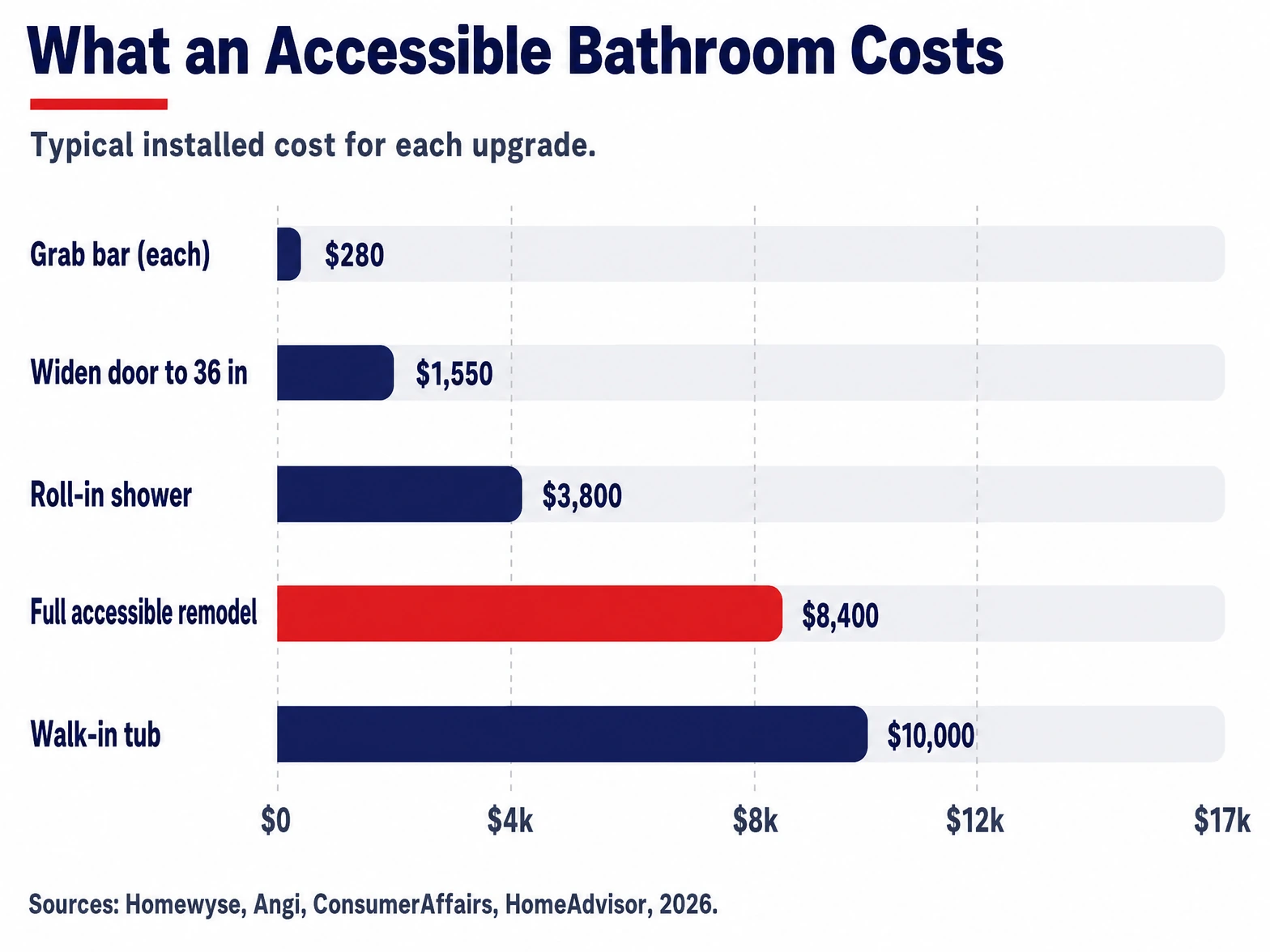
Remodeling a bathroom for accessibility costs between $2,700 and $16,000, and most homeowners pay about $8,400, according to HomeAdvisor’s cost data updated June 19, 2026 (HomeAdvisor, 2026).
The range is wide because “accessible” means different things to different people. One household needs two grab bars and a raised toilet seat. Another needs a roll-in shower, a wider door, and room to turn a wheelchair.
Angi puts the range at $3,000 to $25,000 for making an existing bathroom accessible. Building a brand-new ADA-style bathroom can cost as much as $50,000 (Angi, 2026). For comparison, the 2026 U.S. Houzz Bathroom Trends Study put the national median for a major bathroom remodel at $25,000 in 2025.
Across all bathroom upgrades, the Houzz median was $15,000. A targeted accessibility project often costs less than a cosmetic remodel. You change the parts that matter and leave the rest.
Cost by Upgrade
| Upgrade | Typical installed cost (2026) | Source |
|---|---|---|
| Grab bar, professionally installed | $158 to $398 per bar | Homewyse, May 2026 |
| Toilet installation (comfort-height or standard) | $224 to $533 labor, avg. $374, plus the fixture | Angi, May 2026 |
| Accessories: grab bars, handheld shower, bench | $300 to $2,000 | HomeAdvisor, June 2026 |
| Roll-in shower conversion kit (shower already big enough) | $600 to $3,200 | Angi, July 2026 |
| Widen a doorway to 32 inches | $300 to $1,000 | Angi, May 2026 |
| Widen a doorway to 36 inches | $600 to $2,500 | Angi, May 2026 |
| Roll-in shower, installed | $2,900 to $4,600 typical (avg. $3,800) | Angi, July 2026 |
| Walk-in tub, standard, installed | $3,000 to $17,000 | ConsumerAffairs, Aug. 2026 |
| Non-slip tile and waterproof wall panels | $4,500 to $8,500 | HomeAdvisor, June 2026 |
| Full accessible bathroom remodel | $2,700 to $16,000 (avg. $8,400) | HomeAdvisor, June 2026 |
Twin Cities labor runs close to these national figures, but the house matters more than the zip code.
Four things push a project toward the high end: moving the drain, removing a tub, reframing a doorway, or finding rot in the subfloor or the wall behind the old tile. A free in-home estimate will tell you which of those apply before you commit.
Why Is the Bathroom the First Room to Modify?
Because that’s where people get hurt. A 2011 CDC analysis of emergency room data found that falls caused 81.1% of nonfatal bathroom injuries (CDC MMWR). The risk climbs fast with age.
The injury rate was 112 per 100,000 people at ages 65 to 74 and 515 per 100,000 at 85 and older. Bathing or showering was the precipitating event in 27.5% of injuries and slipping in another 17.3%. A further 14.1% happened while standing up from, sitting down on, or using the toilet.
In Minnesota, falls sent about 12,000 adults 65 and older to the hospital in 2024, and 30,000 more to the emergency room. The state also has the second-highest older-adult fall death rate in the country, according to the Minnesota Department of Health (MDH, Preventing Falls).
Not all of those falls happen in bathrooms. But no other room combines as many risks: water, hard surfaces, tight space, and transfers.
Homeowners already know this. The 2026 Houzz Bathroom Trends Study found 71% of renovating homeowners address special needs in their bathroom projects, and among those addressing current needs, 43% are doing it for aging household members (Houzz, 2026).
Most of them are planning ahead: 55% expect the need to arise five or more years from now. For a broader look at the whole house, see our room-by-room home modifications guide for aging in place.
Which Features Make a Bathroom Accessible?
An accessible bathroom, also called a wheelchair-accessible bathroom, handicap-accessible bathroom, or ADA-compliant bathroom, lets the person who uses it get in, move around, bathe, and use the toilet safely, with less help or none.
The measurements below come from the 2010 ADA Standards for Accessible Design, as explained by the U.S. Access Board (Access Board, Toilet Rooms; Access Board, Bathing Rooms). The ADA covers public buildings, not private homes, so nobody will inspect your bathroom against it.
But it’s the best-tested guide to what a person using a walker or wheelchair needs. A good design starts there, then adjusts to the person.
Grab Bars
Grab bars are the most common aging-in-place project for a reason. In NAHB’s 2023 Remodeling Market Index survey, 93% of remodelers doing aging-in-place work had installed grab bars in the past year.
Curbless showers (83%) and higher toilets (77%) came next (NAHB Eye on Housing, May 2023). The 2026 Houzz study found the same pattern among homeowners, with grab bars at the top of the list at 63%.
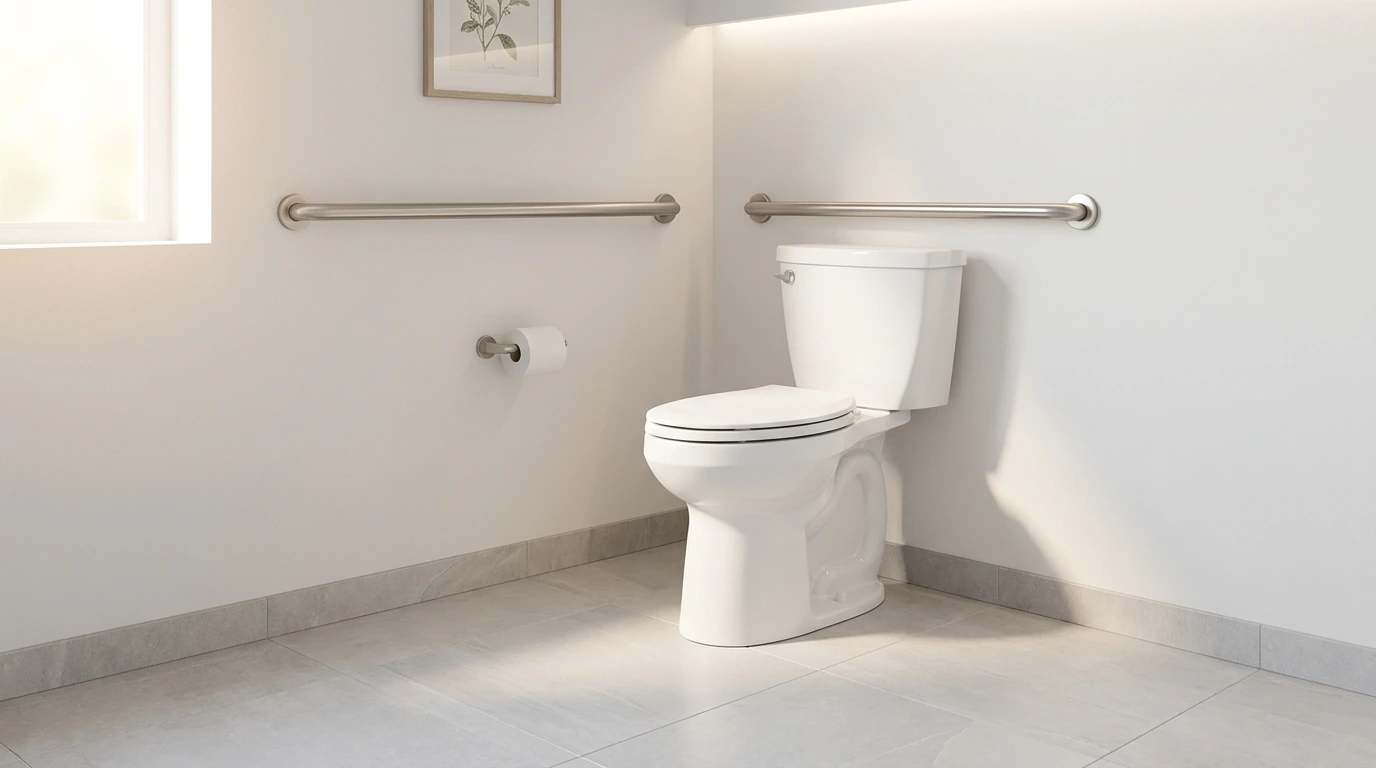
The ADA reference points are simple. The ADA grab bar height range is 33 to 36 inches above the floor, with a 1¼ to 2 inch diameter and 1½ inches of clearance from the wall. They must hold 250 pounds of force.
That’s why a grab bar has to be anchored into studs or solid blocking. A towel bar, or a grab bar on drywall anchors, can pull out under a falling adult. See the styles and finishes we install on our grab bars page.
The Shower: Roll-in, Low-Curb, or Transfer
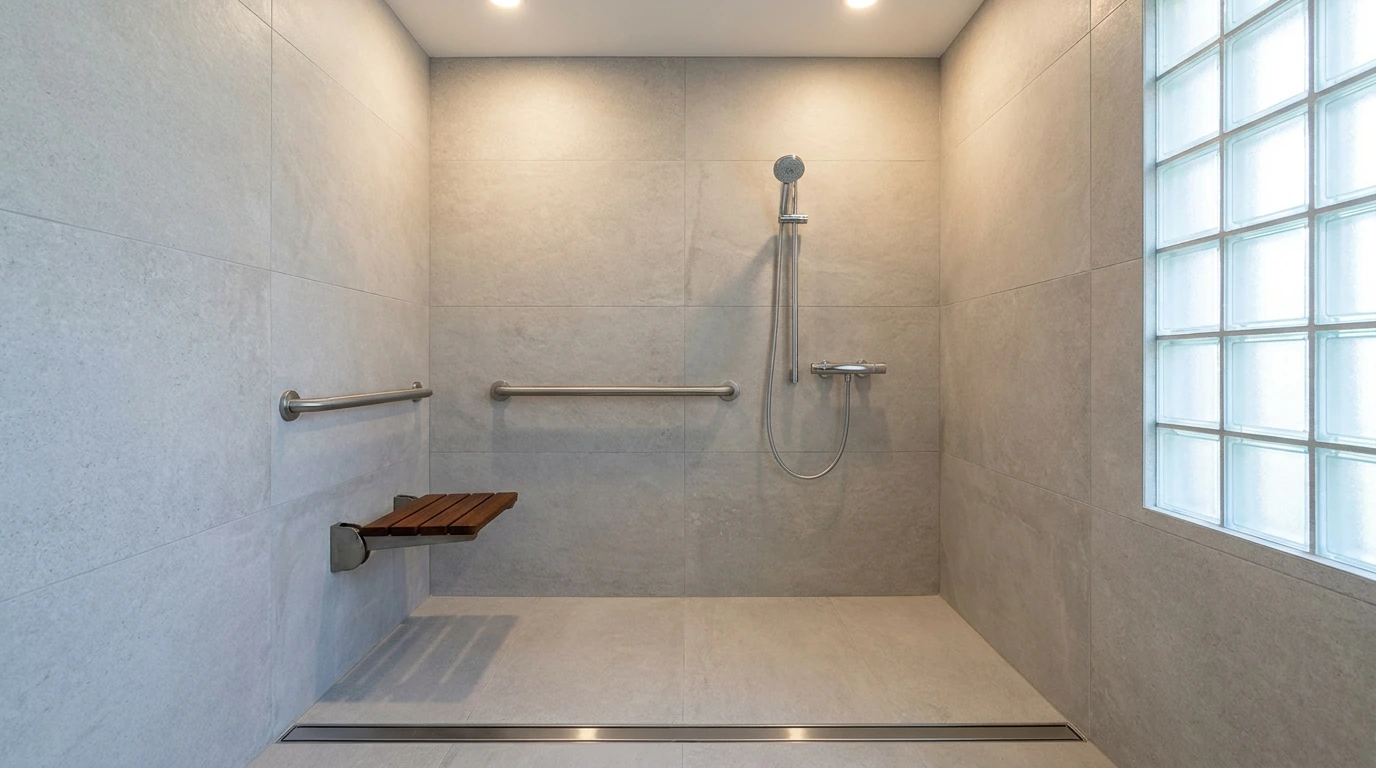
Most accessible bathroom budgets are decided here. A roll-in shower, also called a wheelchair-accessible shower, has no curb, or a beveled threshold no higher than ½ inch. A shower wheelchair can roll straight in. The ADA shower size minimum is 30 by 60 inches, with a 60-inch-wide opening.
Angi’s 2026 data puts the national average at $3,800 installed, with most projects between $2,900 and $4,600 (Angi, July 2026). If the existing shower is already big enough, a conversion kit starting around $600 can work. Our roll-in showers page shows finished installs.
A low-curb shower keeps a small lip at the entry and is what most people renovating for aging in place pick: 55% in the Houzz study, versus 32% for fully curbless.
It’s cheaper because the floor doesn’t need to be recessed. It works well for someone who walks with a cane or walker. If a wheelchair is likely, a curbless shower is the better long-term choice.
Whatever the entry, add a fold-down or built-in seat 17 to 19 inches high and a handheld shower on a slide bar. Put the controls where a seated person can reach them. The ADA sets them no higher than 48 inches and, with a seat, within 27 inches of the seat wall.
Walk-in Tubs
A standard walk-in tub costs $3,000 to $17,000 installed, and higher-end models can pass $30,000, according to ConsumerAffairs (ConsumerAffairs, August 2026). Soaker models run $2,000 to $10,000 and hydrotherapy models $5,000 to $15,000.
They suit people who benefit from soaking and can still step over a low door sill. The catch is time. You sit in the tub while it fills and drains, which matters in a cold Minnesota bathroom. Compare models on our walk-in tubs page.
Roll-in shower or walk-in tub? If the person uses a wheelchair, a shower chair, or can’t stand long, a roll-in shower is more practical and usually costs less.
If warm soaking helps arthritis or chronic pain and they can step over a low sill, a walk-in tub fits. Minnesota waivers can pay for either when it meets an assessed need. They won’t pay for features that are mainly for comfort or convenience.
Toilet
The ADA puts the top of the toilet seat 17 to 19 inches above the floor. Manufacturers sell this as “comfort height” or “chair height,” and standard toilets are usually lower.
The ADA also sets the toilet’s center 16 to 18 inches from the side wall, so a grab bar on that wall is within reach. Professional toilet installation runs $224 to $533 in labor, about $374 on average, plus the fixture (Angi, May 2026). It’s one of the best values in the whole project.
Sink and Vanity
A wheelchair user needs open knee space under the sink. That means a wall-hung sink or an open vanity, with the hot water pipes covered. For everyone else, lever faucets, D-shaped cabinet pulls, and a mirror that tilts or extends low enough to use while seated make daily routines easier.
Doors and Turning Space
A wheelchair needs a 60-inch circle (or a T-shaped space) to turn around. It also needs a doorway with at least 32 inches of clear opening. Most bathroom doors in older homes are 28 to 30 inches.
How big does the room need to be? There’s no single required ADA bathroom size for a home. The ADA pieces are a 60-inch turning circle, a clear space 60 inches wide by 56 inches deep at the toilet, and for a roll-in shower, a 30-by-60-inch stall with a 30-by-60-inch clear space in front.
The ADA lets the turning space overlap those clearances, which is how designers fit everything into a smaller room. When space is short, the old tub alcove is usually where the new shower goes. Houzz found 79% of homeowners who remove a tub use the space to enlarge the shower.
Widening one to 32 inches costs $300 to $1,000, or $600 to $2,500 for 36 inches, per Angi (Angi, May 2026). Offset hinges are the cheap alternative and add about 2 inches. A pocket door or an out-swinging door also frees floor space. And if someone falls against it, nobody is trapped behind it.
Flooring and Lighting
Choose matte, slip-resistant tile or sheet vinyl. Use small tiles in the shower, since the extra grout lines add grip. Light the room evenly with no dark corners, and add a light inside the shower.
Put a motion-activated night light on the route from the bed. Rocker switches at the door are easier than toggles for stiff hands.
Planning an Accessible Bathroom in the Twin Cities?
Ocel Builders is a Certified Aging-in-Place Specialist and a Minnesota DHS waiver provider. We do free in-home evaluations across the metro and give you an itemized bid you can use with a case manager or on your own.
What Safety Upgrades Can You Make at Each Budget?
You don’t have to do everything at once. Here’s how the upgrades usually group by cost, using the 2026 figures above. Each tier is a rough total for the whole group, not a quote. Start at the top and work down as needs change.
About $500 to $2,500: The Quick Fixes
- Two or three grab bars anchored into studs or blocking, at the toilet and in the tub or shower
- A comfort-height toilet, or a raised seat with arms as a stopgap
- A handheld shower on a slide bar, plus a freestanding shower bench or tub transfer bench
- Non-slip strips or coating in the tub, and a rubber-backed bath mat
- Lever faucet and door handles, a night light, and offset hinges on the door
Each item costs well under $1,000 on its own. Grab bars run $158 to $398 each installed (Homewyse), and toilet labor runs $224 to $533 plus the fixture (Angi). The full set usually lands in this range.
About $1,000 to $5,000: Fix the Bathing Area
- A tub-to-shower conversion with a low curb, or a roll-in shower where the space allows
- A built-in or fold-down shower seat with blocking behind the wall
- Widening the bathroom door to 32 or 36 inches in a non-load-bearing wall
About $5,000 to $17,000: A Full Accessible Remodel
- A curbless shower with a recessed floor and linear drain
- A walk-in tub, if soaking matters
- Slip-resistant tile throughout, a wall-hung or open vanity, and a layout with a 60-inch turning circle
- Blocking behind every wall for grab bars you might add later
$17,000 and Up: Adding or Relocating a Bathroom
If the only full bathroom is upstairs and the stairs are getting hard, there are two choices: a new first-floor bathroom or a stair lift.
A new accessible bathroom can reach $50,000, per Angi. A straight stair lift is usually far cheaper, which is why we often price both. See our stair lift options if that’s your situation.
The one item we push on every bathroom job, no matter the budget, is blocking. If the walls are open anyway, add solid wood blocking between the studs at grab-bar height.
Blocking costs very little, and a grab bar can go anywhere later without opening the tile. Houzz found that 55% of homeowners planning for special needs expect them to arise five or more years out. Blocking is how you plan for that without paying for it twice.
Who Pays for an Accessible Bathroom Remodel in Minnesota?
Original Medicare doesn’t. Its durable medical equipment reference list denies grab bars by name, as a “self-help device” that is “not primarily medical in nature,” and denies bathtub lifts and bathtub seats on the same basis (CMS, NCD 280.1). The National Council on Aging notes that stair lifts fall in the same home-modification bucket as ramps, widened doorways, and bathroom grab bars (NCOA).
Some Medicare Advantage plans include a small home-safety allowance, so it’s worth calling the plan.
If you’ve been searching for bathroom remodel grants for seniors, the closest thing for most Minnesota families is the state’s waiver programs, below. Some cities and counties also run home repair programs, so ask your local housing office.
Minnesota DHS Waivers
For how these programs fit alongside the ADA, the state building code and the permit you will need, see our guide to Minnesota accessibility laws for homeowners. Minnesota’s waiver programs pay for bathroom modifications as environmental accessibility adaptations (EAA), covering grab bars, accessibility flooring and widened doorways when they meet an assessed need. Six programmes qualify, and the annual limit is generous enough for a full accessible bathroom in most homes.
DHS resets those limits every January, so rather than repeat figures that go stale, we keep the current numbers and the exception process in one place: does Minnesota Medicaid or a DHS waiver cover home modifications?
EAA doesn’t cover changes made for comfort or convenience (Minnesota DHS, CBSM). The project must be approved by the lead agency before work starts.
If you already have a case manager, they can send us a DHS waiver referral.
Medical Expense Tax Deduction
IRS Publication 502 lets you count home improvements whose main purpose is medical care as medical expenses.
Improvements that don’t raise your home’s value, including “installing railings, support bars, or other modifications to bathrooms,” can usually be counted in full; for others, you subtract any increase in home value (IRS Publication 502).
The deduction only helps if you itemize on Schedule A and your total medical expenses come to more than 7.5% of your adjusted gross income, so ask a tax preparer before you count on it.
Veterans’ Benefits and Private Pay
Veterans with service-connected disabilities may qualify for VA home modification grants. For everyone else, it’s private pay, and that’s where a contractor who breaks the bid into “safety” and “finish” items helps you put the money where it counts. Ocel also offers financing for larger projects.
How Should You Plan the Remodel?
- Start with the person, not the room. Does the person use a cane, walker, or wheelchair now? What’s likely in two to five years? A shower that works with a walker but not a wheelchair may not last long.
- Get an assessment. An occupational therapist or a Certified Aging-in-Place Specialist (CAPS) can watch how the person actually uses the bathroom. Minnesota DHS accepts CAPS as one of the credentials qualified to do waiver-funded home modification assessments.
- Check funding before you call a contractor. If a waiver might apply, talk to the case manager first. Work started before approval may not be reimbursed.
- Get an itemized bid. Ask for materials and labor broken out, with accessibility items listed apart from cosmetic ones. A case manager, a family, or a tax preparer can then see what’s what.
- Plan for the time without a bathroom. A roll-in shower takes two to four days to install, per Angi. A full remodel takes longer. If it’s the only bathroom, arrange where the person will bathe in the meantime.
Matt Ocel has more than 30 years of construction experience in Minnesota, has owned Ocel Builders since 2006, and has held CAPS certification since the same year. What we’ve found is that the best accessible bathrooms don’t look accessible. Grab bars come in finishes that match the faucet.
A curbless shower reads as a modern design choice. And a comfort-height toilet is what most buyers want anyway. You can see examples of walk-in tubs, wall surrounds, and roll-in showers we’ve installed in Minnesota homes.
Frequently Asked Questions
How Much Does an Accessible Bathroom Remodel Cost?
Most cost between $2,700 and $16,000, with an average of about $8,400, according to HomeAdvisor’s June 2026 data. Grab bars and a raised toilet sit at the low end.
A full conversion with a roll-in shower, a wider door, and new flooring sits at the high end, and building a new ADA-style bathroom from scratch can reach $50,000.
How Big Does an Accessible Bathroom Need to Be?
There’s no single required size for a home. The ADA guide calls for a 60-inch turning circle, a 60-by-56-inch clear space at the toilet, and, for a roll-in shower, a 30-by-60-inch stall with a 30-by-60-inch clear space in front.
The turning circle may overlap those clearances, so a well-planned layout fits more than you might expect. The old tub space is often where a roll-in shower goes.
Is a Roll-in Shower or a Walk-in Tub Better for Seniors?
For most people, a roll-in shower. It works for anyone who uses a wheelchair or shower chair, or who struggles to step over a sill. It also costs less: about $3,800 on average, versus $3,000 to $17,000 for a standard walk-in tub.
A walk-in tub makes sense when soaking helps arthritis or chronic pain. The person still needs to step over a low sill and wait while the tub fills and drains.
Does Medicare Pay for an Accessible Bathroom Remodel?
No. Original Medicare doesn’t pay for home modifications, and insurers treat bathroom grab bars, ramps, and widened doorways as home modifications rather than durable medical equipment.
In Minnesota, the Elderly Waiver, Alternative Care and the disability waivers all cover accessibility adaptations up to an annual limit DHS resets each January; the current figures are here. Some Medicare Advantage plans offer a small home-safety allowance.
Can I Deduct an Accessible Bathroom Remodel on My Taxes?
Sometimes. IRS Publication 502 lets you count improvements whose main purpose is medical care as medical expenses.
Railings, support bars, and other bathroom modifications for a disability usually don’t raise home value, so their full cost can count. You have to itemize and exceed the IRS medical expense threshold, so check with a tax professional.
How Long Does an Accessible Bathroom Remodel Take?
Grab bars and a comfort-height toilet take a day or less. A roll-in shower takes two to four days to install, per Angi, and a walk-in tub one to four days depending on type, per ConsumerAffairs.
A full remodel that moves plumbing or widens a door can take several weeks, and waiver-funded projects add time for approval before work starts.
The Bottom Line
For most homes, the bathroom is the first room worth making accessible. Start with the quick fixes: grab bars in solid blocking, a comfort-height toilet, a handheld shower, and a non-slip floor.
Each costs well under $1,000, the set usually runs $500 to $2,500, and together they target the most common causes of bathroom falls.
A roll-in or low-curb shower is the next step, at around $3,800 on average. A full remodel averages about $8,400. In Minnesota, a waiver can cover most or all of it for people who qualify.
If you’d like help deciding what your bathroom needs, Ocel Builders offers free in-home evaluations across the Twin Cities metro. For the rest of the house, start with our room-by-room aging in place checklist, linked above.
This article is general information, not medical, tax, or legal advice. Measurements reference the ADA Standards, which govern public facilities, and are used here as a design guide for private homes. Costs are national published ranges and vary by home.
Last reviewed 31 October 2026. This article is general information about accessible bathroom costs, design guidance and Minnesota funding programmes, not legal, medical or tax advice. Prices move, waiver limits are reset by DHS, and the medical-expense deduction depends on your own return. Confirm anything you plan to rely on with your lead agency, your local building department, or a tax preparer.
Sources
- HomeAdvisor, “How Much Does Building an Accessible Bathroom Cost? [2025 Data]”, updated 2026-06-19, retrieved 2026-10-31, https://www.homeadvisor.com/cost/additions-and-remodels/accessible-bathroom/
- Angi, “How Much Does It Cost to Make My Home Wheelchair Accessible? [2026 Data],” retrieved 2026-10-31, https://www.angi.com/articles/how-much-does-it-cost-make-my-home-handicap-accessible.htm
- Homewyse, “Cost to Install Grab Bars,” May 2026 estimate, retrieved 2026-10-31, https://www.homewyse.com/services/cost_to_install_grab_bars.html
- Angi, “How Much Does Toilet Installation Cost? [2026 Data],” updated 2026-05-30, retrieved 2026-10-31, https://www.angi.com/articles/how-much-does-toilet-installation-cost.htm
- Angi, “How Much Does a Roll-In Shower Cost? [2026 Data],” updated 2026-07-09, retrieved 2026-10-31, https://www.angi.com/articles/cost-to-install-accessibility-shower.htm
- Angi, “How Much Does Widening a Doorway for Wheelchair Access Cost? [2026 Data],” updated 2026-05-03, retrieved 2026-10-31, https://www.angi.com/articles/widen-doorway-cost.htm
- ConsumerAffairs, “How Much Do Walk-In Tubs Cost? (2026),” updated 2026-08-28, retrieved 2026-10-31, https://www.consumeraffairs.com/homeowners/walk-in-tub-cost.html
- Centers for Disease Control and Prevention, “Nonfatal Bathroom Injuries Among Persons Aged ≥15 Years, United States, 2008,” MMWR 2011, retrieved 2026-10-31, https://www.cdc.gov/mmwr/preview/mmwrhtml/mm6022a1.htm
- Minnesota Department of Health, “Preventing Falls,” retrieved 2026-10-31, https://www.health.state.mn.us/people/falls/index.html
- Houzz, “5 Bathroom Remodeling Trends to Know in 2026” (2026 U.S. Houzz Bathroom Trends Study), retrieved 2026-10-31, https://www.houzz.com/magazine/5-bathroom-remodeling-trends-to-know-in-2026-stsetivw-vs~185776140
- U.S. Access Board, “Guide to the ADA Accessibility Standards, Chapter 6: Toilet Rooms,” retrieved 2026-10-31, https://www.access-board.gov/ada/guides/chapter-6-toilet-rooms/
- U.S. Access Board, “Guide to the ADA Accessibility Standards, Chapter 6: Bathing Rooms,” and 2010 ADA Standards sections 608 and 610, retrieved 2026-10-31, https://www.access-board.gov/ada/guides/chapter-6-bathing-rooms/
- National Association of Home Builders, Eye on Housing, “Grab Bars Remain the Most Common Aging-in-Place Remodel,” 2023-05-09, retrieved 2026-10-31, https://eyeonhousing.org/2023/05/remodeling-market-index-rmi-special-question-analysis-aging-in-place/
- National Council on Aging, “Does Medicare Cover Stair Lifts?”, retrieved 2026-10-31, https://www.ncoa.org/article/medicare-and-stair-lifts/
- Minnesota Department of Human Services, “Long-Term Services and Supports Service Rate Limits, DHS-3945,” effective 2026-10-01, retrieved 2026-10-31, https://edocs.dhs.state.mn.us/lfserver/Public/DHS-3945-ENG
- Minnesota Department of Human Services, “CBSM, Environmental accessibility adaptations,” updated 2026-03-18, retrieved 2026-10-31, https://www.dhs.state.mn.us/id_002196/
- Internal Revenue Service, “Publication 502 (2025), Medical and Dental Expenses,” Capital Expenses, retrieved 2026-10-31, https://www.irs.gov/publications/p502
- Centers for Medicare & Medicaid Services, “NCD – Durable Medical Equipment Reference List (280.1),” retrieved 2026-10-31, https://www.cms.gov/medicare-coverage-database/view/ncd.aspx?ncdid=190